

This is the third in a series of five posts, each focused on a single word. Words that shape how women show up in their careers, their relationships, and their lives. Last week I wrote about purpose. This week: focus. The word that determines what gets your attention.
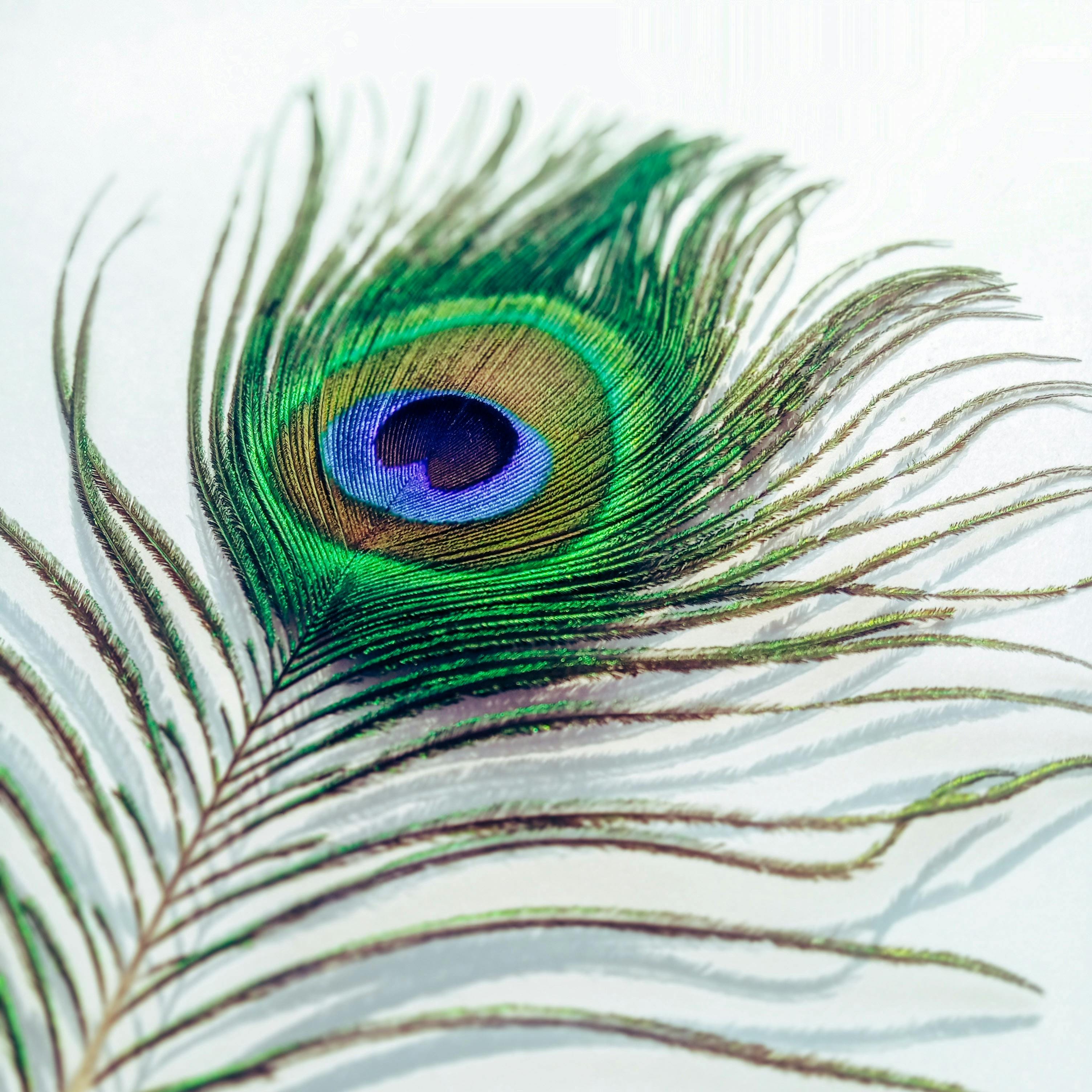
Years ago, I was in a women’s leadership program and I vividly remember an exercise we did. The facilitator passed out peacock feathers (full length 3-5 foot feathers) to each of us. She asked us to balance the feather on one finger. Being competitive, all of us dove in to see who could balance it first. And everyone struggled. We were diving around, catching the feather, trying to figure out how to do it, and then declaring that it wasn’t possible. Well, we all had instinctively focused on the point where the feather met our finger.
Then she asked us to change our point of focus, and lift our gaze to the “eye” of the feather (the beautiful, colorful part at the top). And instantly, we could balance it on our finger tip. Indeed it worked! We all were successfully (and much more peacefully) balancing this 4 foot feather on our fingertip.
The facilitator wasn’t teaching balance. She was teaching us the value of intentional focus. When you focus narrowly, on the immediate contact point, or on the urgent task, the fire in front of you, you lose the whole thing. When you shift your focus up and out, to the “eye” of the peacock feather, to the bigger picture, something counterintuitive happens: the whole thing stabilizes. The lesson was when you have the right focus, the broader, more expansive focus, and not the narrow, immediate or urgent focus, you are successfully able to achieve balance.
It was such a beautiful lesson to physically feel the difference in energy required to balance the feather. And something that stuck with me. Yet, I find myself wrestling with this in my everyday life. My focus and energy are drawn to the urgent issues, or demands and requests from others, leaving me feeling scattered.
Focus Is a Lens
I’ve thought about that peacock feather exercise many times over the years. Especially lately, as I’ve been contemplating this word: focus.
Not focus in the productivity sense. In the clarity sense.
Because when I started exploring the word itself, I was struck by how many of its definitions centered not on doing, but on seeing:
to concentrate attention or effort
to bring into clear visual definition
a state permitting clear perception or understanding
That last one especially stayed with me. A state permitting clear perception. Not a technique. Not a discipline. A state. Something you arrive at, something you cultivate.
It reminded me of adjusting the focus on a camera lens. You turn it slightly one direction, then the other, fine-tuning until the image sharpens. Too narrow, and you lose perspective. Too broad, and nothing becomes clear.
The lens doesn’t force the image into focus, it creates the conditions for clarity to emerge.
Which brings me back to the feather. The facilitator wasn’t asking us to concentrate harder. She was asking us to adjust where we were looking. To find the right focal point. Not the urgent one, not the obvious one, but the one that let everything else settle.
Maybe that’s what focus really is. Not a productivity tool. A clarity practice.
Why Focus Feels So Hard
It’s easy to read about focus and walk away feeling like the problem is you. Like if you just downloaded the right app, batched your notifications, or woke up earlier, you’d finally be able to concentrate. The self-improvement industry has made a fortune on that premise.
But here’s what the research actually tells us.
Researcher Gloria Mark spent years studying how people work at UC Irvine and found that after a single interruption, it takes an average of 23 minutes to return to a task. Not 23 seconds. Twenty-three minutes. And most of us aren’t dealing with one interruption, we’re navigating a near-constant stream of them. (If this finding stops you in your tracks the way it did me, her book Attention Span is worth your time.)
I know this feeling: trying to think through a strategic decision while simultaneously tracking three other things I promised I wouldn’t forget.
That’s not a personal discipline problem. That’s a systems problem.
And women carry what researchers call “cognitive labor”: the invisible, ongoing mental work of tracking schedules, anticipating needs, managing emotional dynamics, and holding the details that keep everything running for our families and our teams. It runs in the background, always. Long before we ever sit down to “focus,” our attention has already been claimed.
Then comes the double bind: we’re expected to be responsive, available, and attuned to others, and then questioned for lacking strategic clarity or vision. We’re asked to focus while the conditions for focus are being systematically eroded.
This isn’t a willpower problem. It’s not a productivity hack problem. The difficulty is real, and it is structural. Naming it that way, and seeing it clearly, is itself an act of focus.
Where Are You Actually Looking?

Think back to the peacock feather. When we were asked to balance it, we all did the same thing: we looked down. At the point of contact. At the immediate problem. And the feather wobbled, lurched, fell.
That’s narrow focus. It’s not a character flaw. It’s a natural response to pressure. When something feels urgent or unstable, we zoom in. We react. We try harder, focused on the thing right in front of us. But narrow focus has a way of becoming its own kind of trap. When we’re zoomed in on the immediate point of tension, we lose sight of the larger picture. Like a camera lens pulled too tight, it distorts as much as it clarifies.
Expansive focus is the shift the facilitator asked us to make. Lifting our gaze to the eye of the feather. And here’s what’s important: expansive focus is not the same as distraction. It’s not losing concentration or letting everything go blurry. It’s widening the frame enough to see what actually matters. Your purpose. Your values. The relationships and long-term direction that give the immediate work its meaning. When you’re oriented toward those things, something counterintuitive happens: the details don’t disappear, they just find their right place.
Strong leaders know when to zoom in and when to zoom out. The skill isn’t choosing one over the other permanently, it’s learning to move between them with intention.
But there’s something that makes this harder than it sounds, and it’s worth naming directly. We tend to think of focus as a matter of duration — how many uninterrupted hours we can log, how long we can sustain concentration. The productivity world sells it this way: Pomodoro blocks, deep work sessions, distraction-free mornings. And those things have their place.
What the feather taught me is something different. And I think it offers two reframes worth sharing.
Focus is a direction, not a duration. The feather taught me that where you aim your gaze matters more than how long you hold it. The question isn’t “how do I focus for longer?” It’s “what is my eye of the feather?” What is the thing that, when you orient toward it, lets everything else settle?
Reclaiming focus starts with honest awareness. Before we can find our eye of the feather, we have to answer a harder question first: where is your attention actually going right now? Not where you intend it to go. Where it actually lands, day after day. This is where the reclaiming starts. Not with a new system or a better schedule, but with clear-eyed noticing. What are you centering by default, without having chosen to? Once you can see that, you can begin to choose differently.
Choosing What Comes Into Focus
Maybe focus isn’t something we force. Maybe it’s something we cultivate, by adjusting the lens, lifting our gaze, and returning, again and again, to the thing that actually matters.
The peacock feather didn’t require more effort. It required a different approach. And I think that’s true for us too.
Focus is not a fixed state. It’s an ongoing recalibration. We zoom in when we need to. We zoom out when we’ve lost the thread. We notice when our attention has been claimed by something we didn’t consciously choose, and we gently redirect.
What we focus on shapes what we’re able to see. And over time, it shapes our lives.
So this week, before optimizing your schedule or attempting another focus strategy, try something simpler: notice. Where does your attention go first in the morning? What claims it before you’ve chosen to give it? And is there an eye of the feather – something you could orient toward that would let everything else settle?
What are you focusing on?
Next week: Time. Because once you have clarity about where you’re looking, the next question becomes: Do you actually have the conditions to look there? Looking forward to exploring it with you. Until then, keep carving your path.